
Black Bear Scat and Tracks: How to Identify Them (Ursus americanus)
Quick answer
Black Bear sign: scat size, shape and contents, track size, toes and gait, and how to tell it from Domestic Dog, quoted from state wildlife agencies, the National Park Service and the CDC.
Updated 2026-09-10 · Sources: Missouri Dept. of Conservation, Wildlife Illinois (University of Illinois Extension)
Found one? Take a photo to identify it.
Download on the App StoreWhat are the key facts?
- Scientific name: Ursus americanus
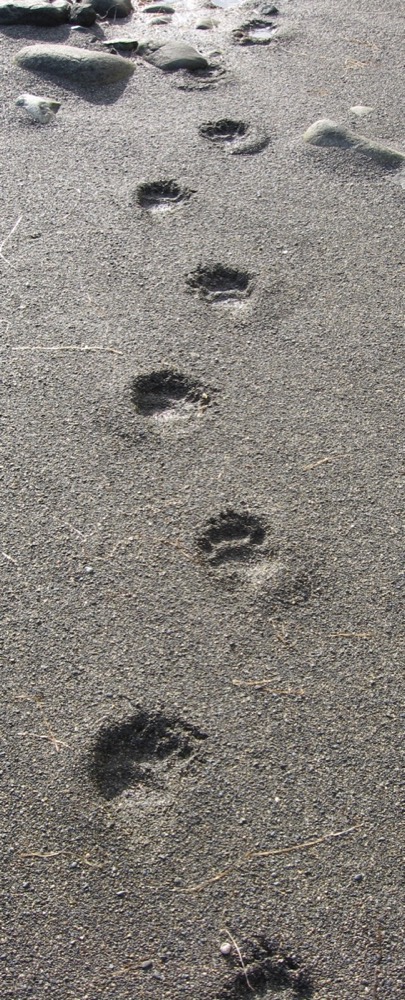
- Tracks: Front: Front foot about 3.75 inches long (varies considerably between individuals) · Hind: Hind foot about 8 inches long, usually 5 toes though the innermost small toe may not register · Toes: 5 toes on both front and hind feet · Claws usually do not show · Gait: The hind footprint often looks like a human footprint left by a soft moccasin
Reading Black Bear sign: start here
Carnivore scat is tubular, often twisted and tapered at one end, and full of hair, bone fragments, berries or seeds depending on the season. Dog-family tracks show four toes with claw marks and an X drawn between the pads; cat-family tracks show four toes with no claws and a three-lobed heel pad. Many carnivores leave scat on trails, rocks and junctions on purpose, so where it sits is a clue in itself. The measurements below for Black Bear are quoted from the wildlife agencies linked at the bottom of the page.
Black Bear tracks
- Front: Front foot about 3.75 inches long (varies considerably between individuals)
- Hind: Hind foot about 8 inches long, usually 5 toes though the innermost small toe may not register
- Toes: 5 toes on both front and hind feet
- Claws usually do not show
- Gait: The hind footprint often looks like a human footprint left by a soft moccasin
Other sign to look for
- Claw marks on trees: Bears leave several distinctive marks on trees, and their claws often leave impressions in soft substrates
- Black Bear scat specimen description (image caption): The source has only an image caption, with no detailed written description of size/shape/contents
Black Bear vs Domestic Dog
An adult bear is far larger than a dog, with a rounder outline, and its very short tail is often held close to the body and hard to see The Domestic Dog page has its own sign list.
How to photograph sign for identification
Put something of known size next to it (a coin, a pen, a boot) and shoot straight down in soft light; low side light brings out the shape of tracks in mud or snow. For scat, photograph the whole deposit and one close-up showing contents. Note where it was: on a log, in the open, on a trail, near water. The app suggests the likely animal; confirm with the size and shape notes above.
FAQ
What do Black Bear tracks look like?
Front: Front foot about 3.75 inches long (varies considerably between individuals). Hind: Hind foot about 8 inches long, usually 5 toes though the innermost small toe may not register. Toes: 5 toes on both front and hind feet. Claws usually do not show. Gait: The hind footprint often looks like a human footprint left by a soft moccasin.
How do I tell Black Bear sign from Domestic Dog?
An adult bear is far larger than a dog, with a rounder outline, and its very short tail is often held close to the body and hard to see
More in Animal Scat and Track Identification
- Coyote Scat and Tracks: How to Identify Them (Canis latrans)
- Gray Wolf Scat and Tracks: How to Identify Them (Canis lupus)
- Red Fox Scat and Tracks: How to Identify Them (Vulpes vulpes)
- Gray Fox Scat and Tracks: How to Identify Them (Urocyon cinereoargenteus)
- Bobcat Scat and Tracks: How to Identify Them (Lynx rufus)
- Mountain Lion Scat and Tracks: How to Identify Them (Puma concolor)
- Raccoon Scat and Tracks: How to Identify Them (Procyon lotor)
- Striped Skunk Scat and Tracks: How to Identify Them (Mephitis mephitis)
- River Otter Scat and Tracks: How to Identify Them (Lontra canadensis)
Related
Learn the wild around you, one capture at a time.
Start with a single photo.
Found one? Take a photo to identify it.
Sources
- Missouri Dept. of Conservationmdc.mo.gov/discover-nature/field-guide/american-black-bear
- Wildlife Illinois (University of Illinois Extension)wildlifeillinois.org/identify-wildlife/black-bear/
Compiled by the NatureLens editorial team
Every fact on this page is taken from the sources listed above; numbers and prices are copied from the source, and prices name the guide or auction and its date. Research and drafting were assisted by AI, and each claim was then checked against the cited sources. Checked 2026-09-10. We do not buy, sell or grade items; the app identifies what you photograph and points you to these references.