
Eastern Cottontail Scat and Tracks: How to Identify Them (Sylvilagus floridanus)
Quick answer
Eastern Cottontail sign: scat size, shape and contents, track size, toes and gait, and how to tell it from Swamp Rabbit / Jackrabbit, quoted from state wildlife agencies, the National Park Service and the CDC.
Updated 2026-09-10 · Sources: Wildlife Illinois (University of Illinois Extension), ICWDM (Purdue University)
Found one? Take a photo to identify it.
Download on the App StoreWhat are the key facts?
- Scientific name: Sylvilagus floridanus
- Scat: Size: Less than 0.5 inches in diameter · Shape: Round balls, left in piles · Contents/color: Dark in color
- Tracks: Toes: 5 toes on the front foot, 4 toes on the hind foot · Gait: While bounding, the hind footprints land side by side ahead of the front footprints, forming a 1-1-2 track pattern
Reading Eastern Cottontail sign: start here
Rabbits and hares leave round, slightly flattened pellets of packed plant fiber, usually in scattered groups where they feed. Their bounding track pattern is distinctive: two long hind prints side by side ahead of two smaller front prints, one behind the other. Clean, angled cuts on twigs and bark at snow height are their feeding sign. The measurements below for Eastern Cottontail are quoted from the wildlife agencies linked at the bottom of the page.
Eastern Cottontail scat: what it looks like
- Size: Less than 0.5 inches in diameter
- Shape: Round balls, left in piles
- Contents/color: Dark in color
Eastern Cottontail tracks
- Toes: 5 toes on the front foot, 4 toes on the hind foot
- Gait: While bounding, the hind footprints land side by side ahead of the front footprints, forming a 1-1-2 track pattern
Other sign to look for
- "Forms" (hollow resting nests) and scraping marks: Cottontails use concealed "forms" made of grass or weeds under vegetation, along with scraping marks
- Gnawing on woody plants: Survives the winter by gnawing bark, buds, and twigs
Eastern Cottontail vs Swamp Rabbit / Jackrabbit
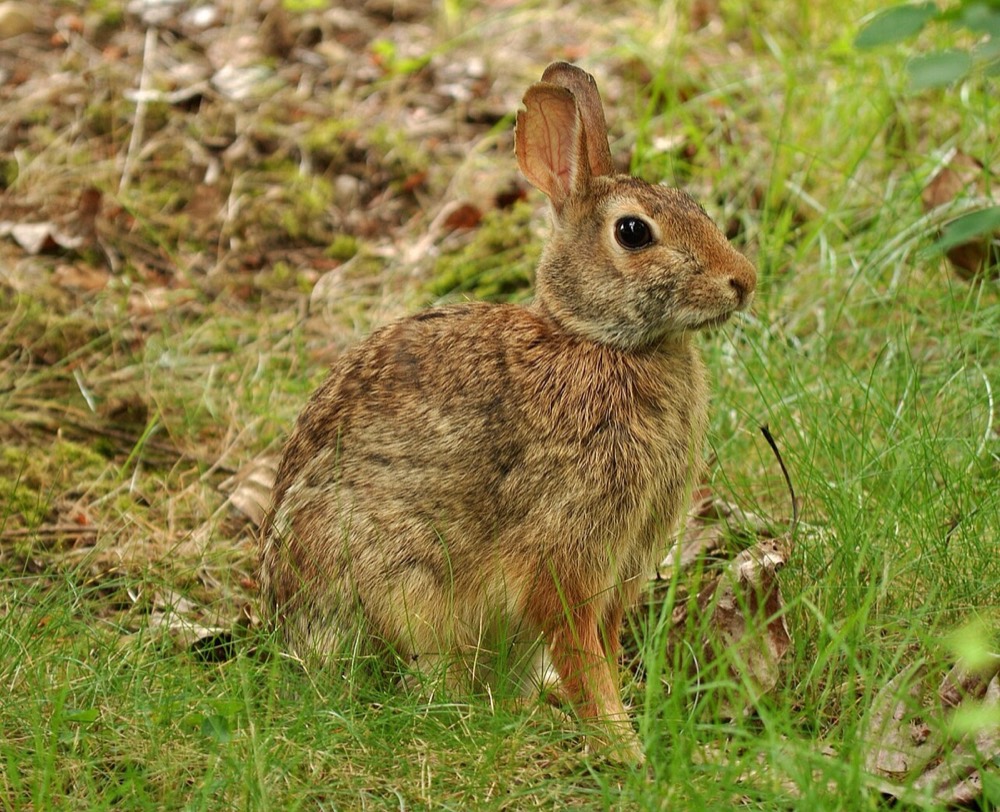
The Swamp Rabbit looks similar to the Cottontail but is larger with a darker, reddish-brown coat; hares in general are larger with longer ears
How to photograph sign for identification
Put something of known size next to it (a coin, a pen, a boot) and shoot straight down in soft light; low side light brings out the shape of tracks in mud or snow. For scat, photograph the whole deposit and one close-up showing contents. Note where it was: on a log, in the open, on a trail, near water. The app suggests the likely animal; confirm with the size and shape notes above.
FAQ
What does Eastern Cottontail poop look like?
Size: Less than 0.5 inches in diameter. Shape: Round balls, left in piles. Contents/color: Dark in color.
What do Eastern Cottontail tracks look like?
Toes: 5 toes on the front foot, 4 toes on the hind foot. Gait: While bounding, the hind footprints land side by side ahead of the front footprints, forming a 1-1-2 track pattern.
How do I tell Eastern Cottontail sign from Swamp Rabbit / Jackrabbit?
The Swamp Rabbit looks similar to the Cottontail but is larger with a darker, reddish-brown coat; hares in general are larger with longer ears
More in Animal Scat and Track Identification
- Beaver Scat and Tracks: How to Identify Them (Castor canadensis)
- Muskrat Scat and Tracks: How to Identify Them (Ondatra zibethicus)
- Porcupine Scat and Tracks: How to Identify Them (Erethizon dorsatum)
- Woodchuck (Groundhog) Scat and Tracks: How to Identify Them (Marmota monax)
- Snowshoe Hare Scat and Tracks: How to Identify Them (Lepus americanus)
- Eastern Gray Squirrel Scat and Tracks: How to Identify Them (Sciurus carolinensis)
- Eastern Chipmunk Scat and Tracks: How to Identify Them (Tamias striatus)
- Deer Mouse Scat and Tracks: How to Identify Them (Peromyscus maniculatus)
- House Mouse Scat and Tracks: How to Identify Them (Mus musculus)
- Rat Scat Identification: Norway Rat Droppings and Tracks
- Meadow Vole Scat and Tracks: How to Identify Them (Microtus pennsylvanicus)
Related
Learn the wild around you, one capture at a time.
Start with a single photo.
Found one? Take a photo to identify it.
Sources
- Wildlife Illinois (University of Illinois Extension)wildlifeillinois.org/identify-wildlife/eastern-cottontail/
- ICWDM (Purdue University)icwdm.org/species/other-mammals/rabbits/
Compiled by the NatureLens editorial team
Every fact on this page is taken from the sources listed above; numbers and prices are copied from the source, and prices name the guide or auction and its date. Research and drafting were assisted by AI, and each claim was then checked against the cited sources. Checked 2026-09-10. We do not buy, sell or grade items; the app identifies what you photograph and points you to these references.